
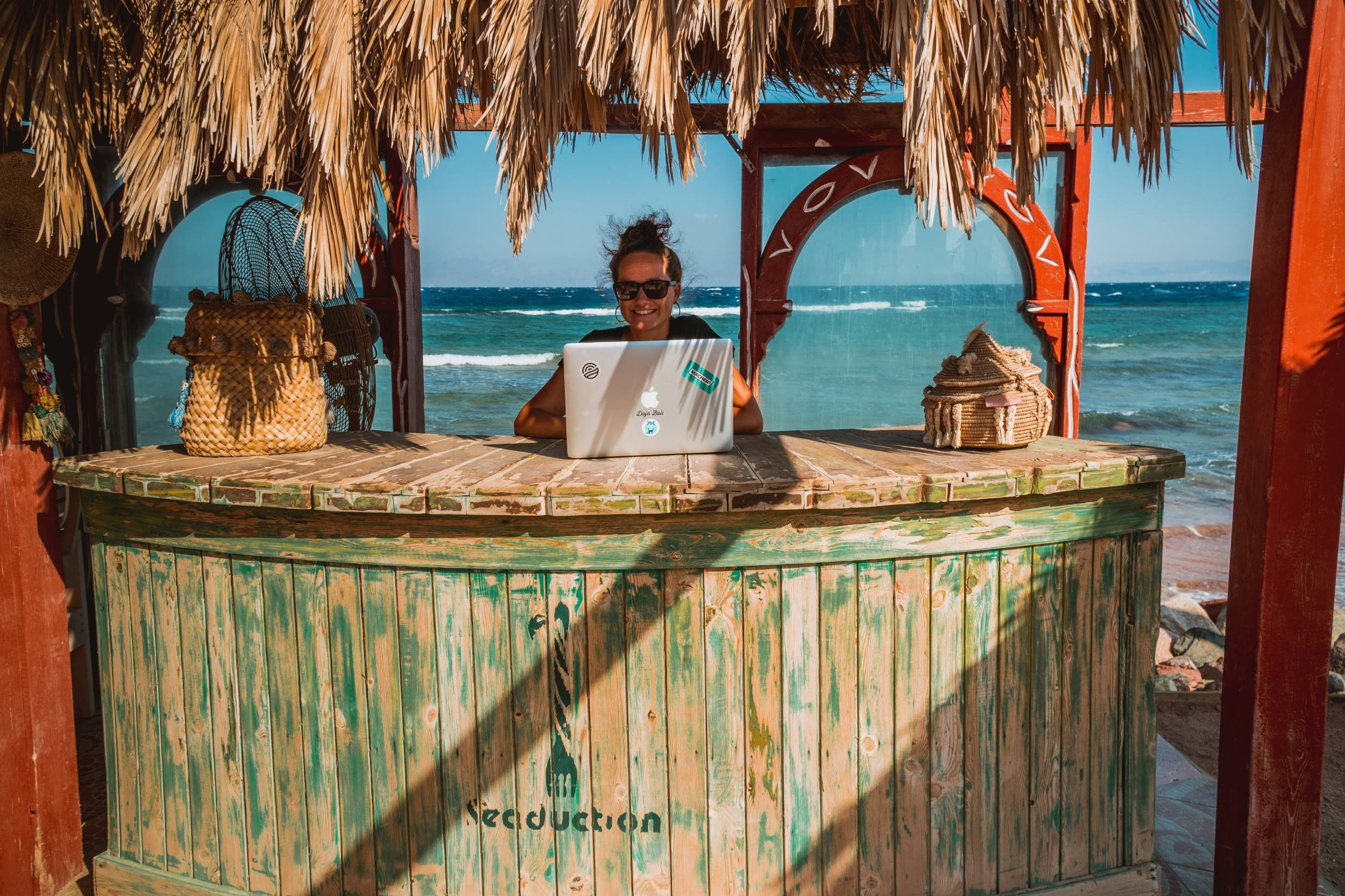
Some would say that the biggest advantage of working as a freelancer is that they are their own boss, while others would say that it is the considerable amount of money that they save from the traveling and other expenses that they would incur if they had a common 9-5er. However, what we forget is one important advantage of working from home – discovering our true potential.
A freelancer has a greater chance of discovering their true potential in terms of what they can do and what they cannot do, and what they can learn to do and cannot because they are out in the open by themselves and have to either have to discover their survival skills or learn some new ones. But of course, while a person might have a talent to do something new, it is not necessary that they have the required skills too.
For example, a content writer may have a talent to become a crackling copywriter, but they might not have the requisite knowhow to make their copy good. Because a person does not have some skills, they may lose out on several lucrative assignments and stop their self-growth. This is because some simply do not want to go ahead and sign up for a course at a institute, because they think (and it may be true too) that they are quite old for the old school bench and table story, while yet others might have liked to acquire a new skill too, but their freelancing life is so full of chaos that they would never make it to the class on time.
However, there is one way to solve this issue – distance education. Distance Education works for a freelancer for many reasons, apart from the common one of saving time or flexible education time. Here are the different reasons distance education works:
Various Colleges, Various Degrees:
If a person researches a bit, they would be surprised to find that their educational qualifications have different weightage in different countries, states and cities. Because a freelancer has the whole world as their market, it is very important for them to take an education or degree that is accepted and revered all through the world. With distance education a freelancer can generally pick and choose any kind of institution and degree that they want.
Affordable Education:
Think about it, if you are undertaking distance education, you save a lot of money. You save money on your daily commute, on the ‘for school’ shopping that you would have to indulge in every six months or so and save up on the amount of money that you would spend on lunches, dinners, coffees if you were on campus.
Global Education:
So, you would like to be educated from an institute that is based in Connecticut but stay in Canada? No issues. Distance Education allows institutes and students to connect on a global level. Whether you are from Melbourne or Connecticut or Stanford, you can choose and decide which institute that you would like to take your degree or certificate from.
That said, distance education is simple and easy, but that does not mean that there are no pointers to keep in mind. While pursuing distance education, you should first find out whether the degree that is being offered has any standing in the local as well as the global market.Though a freelancer has the globe as their market, they need to concentrate on their local market as well the international one.
Another aspect to keep in mind is whether the institution that you are planning to get your education from is legal and providing the educational qualification in the legal way. There are many fake Universities and Institutions that claim to be affiliated with some institutions and colleges, but are actually not.
To find out about the different distance learning colleges and which ones would make sense for you, check out the various websites that offer you information about distance education. These websites give you all the information about all the colleges that offer you distance education.
Globalization and outsourcing has been good for some people and has been terrible for others. While outsourcing has brought food at the tables of many people and leveraged their lifestyle like never before, they have also taken away jobs from many others. It is an unequivocal fact that the call centers in India are actually something that were hammered out of a need of small businesses and companies that could not afford the ‘$8 per hour’ at-home mom to peddle or soft talk about their products that hadn’t yet broken through. Looking at how the President of the Big A is becoming more aggressive about taking back jobs to their country – and they have every right to, what they gave, they can take – and the Government now making life difficult for companies that outsource their work to others, and a situation where a number of individuals, families, countries have slowly risen out of the deep spot because of economic gains due to outsourcing – things are just about to be very interesting.
Add to this the announcement a few days ago where a Senator branded Infosys as a chopsop. Now, for those who do not know what Infosys, let’s give you some information. Infosys is a software development country in India, which is basically the be all and end all of the software world, it’s the final come uppance of a software developer, a post in Infosys, fondly called ‘Infy’ gets you the best seat in the house, the best dish in the house, the best everything. No, the emotion of an American working in Microsoft or an Adobe comes nowhere near the emotion of an Indian working in Infosys – and I do not care about the financial comparisons of both these situations.
So hallowed are these portals, that one of the founders, N. R Narayana Murthy, has been considered to be able to do what Obama’ was/is considered to be able to do for India. Another of the founders, Nandan Nilekani is at the helm of a prestigious and ambitious project directly under the onus of the Indian Government, that is supposed to give all Indian citizens something that is akin to the American social security number. Come to think of it, Obama was the first for America, I guess even Murthy would be a first for America. The first gentleman businessman who ventured into Politics and won! Anyway, I digress, this post is not another glowing tribute to Infy, it’s about that damn sound byte that the Senator gave.
So, let’s delve on the exact quip that Democrat (that’s interesting too, I thought Republicans were against outsourcing) Senator Charles E Schume said about Infosys. What he said was,
“The emergency border funds will be paid for by assessing fees on foreign companies known as chop shops that outsource good, high-paying American technology jobs to lower wage, temporary immigrant workers from other countries. These are companies such as Infosys. But it will not affect the high-tech companies such as Intel or Microsoft that play by the rules and recruit workers in America.”"
Now, I read this remark again and again, and I should tell you – I found nothing wrong with what he said. To understand what this is all about, I shall do what other Indian newspapers and magazines did – describe a chopshop. Yes, that is true. In this great country with one of the oldest civilizations and strongest education system, reading the newspapers would make one seem that the public at large doesn’t know what a ‘chopshop’ is. But I have played GTA in my time, so I can tell you what it is, since there is no Wiki description that is in context with the word here.
A chop shop is a car shop, where cars that are stolen are brought in, tweaked in, painted, and basically made to cover the crime. A chop shop has a number of highly talented people who can work at lightning speed and dismantle and remake a car in record time. And that’s what they should be good at, because the cops are hot on their heels and the wheels gotta go in a few hours anyway. Of course, sometimes a chop shop can be used for lesser harmful activities like illegal modification of the vehicle, but that’s all in the profile anyway.
So, leaving aside the essence of crime, a chop shop can be described as a shop that gets in a product, works on it so that it is better, enhanced, and unrecognizable, in a record time.
Now, lets compare this to Infosys.
So, Infosys does not describe itself on its site, and the Wiki link to Infosys says that it is a Information Technology Services company. That’s correct, for those of who think that it is a Software Development company, that’s the description that it has on the big W and there’s no description of it on its site. And I would like to someone better knowledgable about the realm of software to describe the difference between the two.
What I know, though, is that I have never seen a software from Infosys being as big a success as say a Windows, or even a Adobe Photoshop – and that’s where my issue begins. If you go to their site, which seem quite daunting when you read about them, and I can quite understand if they were the ones that run the machines while I am at the mall, or if they are the ones that allow me to connect faster on my mobile web, so you can at least say that Infosys has done what it had to do in all these years.
And if it has done this, then the PR department of Infosys should have been guillotined a long time ago. Essential software does not PR itself, it needs to be PRed by a talented group of individuals. So maybe the company does not believe in tooting its own drum – but that has never stopped the Indian media from creating a hype and reporting about something, right? And not for a moment do I doubt that it might company policy not to tom tom about their achievements – which is all right as far as corporate ethics go, but is Infosys doing the right thing by staying mum about their achievements when it is the single most recognizable face of a vibrant, talented and enthusiastic workforce that is derided as being ‘software coolies’?
At the face of it all, it seems that Infosys has done great for the situation that it is in, and it is only now that they are understanding what they have created – Infosys is just one of the Economical Frankenstein that has been created by rich countries to bored or lazy to do the hackwork. Are there more? Sure. Are they as successful? Maybe. Do they pose a threat to the better settled companies? Of course they do.
What is sad for India is that there is yet a Indian company that is even near the way their outsourcing counterparts work. They have a five day week, we have a six day week with Sundays probably an off if a system does not crash down on Saturday morning – and that is quite possible to happen because we are running on exclusive timelines – read fake ones. They have medical care, perks, etc, while we just have ourselves to look after if we fall down after working for a horse for fifty years – unless we have our medical insurance in place.
They consider Saturdays and Sundays to be religious offs, while we consider them a great way to either freelance or work double shifts to get that vehicle that we are planning on.
The problem is not a single phased issue that can be solved by cutting down two wires. This issue is a festering wound that has been consistently scratched by a paranoid and sleazy employer base and a guilty, greedy, mostly incompetent employee base that have suddenly been shown the big show and wanna wear those cowboy boots too.
The question is, why do Indian companies not have the same services, features and amenities that are offered by foreign companies? Why do we still piss in our pants when we think about the loss of a big foreign client? Why do companies still close down if some vague foreign client stops giving them the consistent work:?
Infosys is just someone that is caught in the crossfire and unless we don’t set up our secure areas, it’s gonna get bloody.


